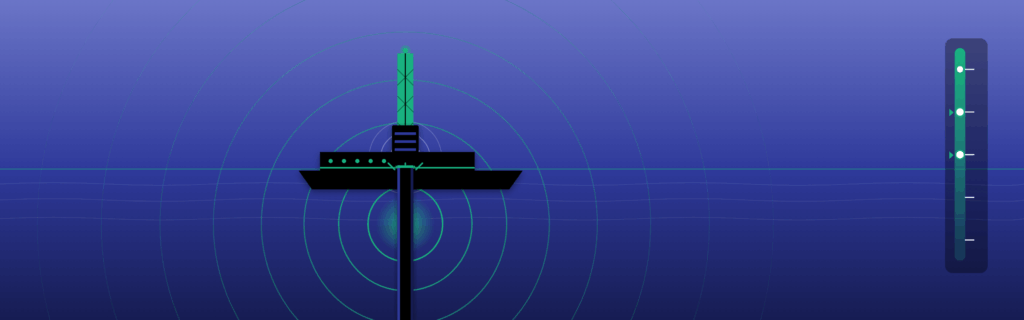
Offshore wind construction produces some of the loudest sounds humans introduce into the ocean. Pile driving can exceed 220 dB re 1 µPa at the source, with measurable effects on marine mammals tens of kilometres away. Three regulatory frameworks set the limits that project teams must respect: JNCC in the United Kingdom, BSH in Germany, and OSPAR across the North-East Atlantic.
This article explains what each framework measures, how their thresholds compare, and what compliance looks like in practice during pile driving operations.
What underwater noise thresholds measure
Regulators do not use a single metric. They use a small set of acoustic measurements that capture different aspects of noise impact on marine life.
Sound Pressure Level (SPL) measures the peak intensity of a sound, in dB re 1 µPa. It is the most intuitive metric but it does not capture cumulative exposure.
Sound Exposure Level (SEL) measures the acoustic energy of a single event integrated over one second, in dB re 1 µPa²·s. It is the standard for assessing risk of permanent hearing damage in marine mammals.
Cumulative SEL (SEL_cum) sums SEL over a 24-hour exposure period. It is the metric that most modern guidelines use to set thresholds for Permanent Threshold Shift (PTS) and Temporary Threshold Shift (TTS).
Single Strike SEL (SEL_ss) measures a single pile strike. It is the metric used in the German BSH framework.
Different species have different hearing groups. The widely used NOAA 2018 classification splits marine mammals into low-frequency (baleen whales), mid-frequency (most dolphins), high-frequency (porpoises) and very high-frequency cetaceans, plus phocid and otariid pinnipeds. Thresholds are typically frequency-weighted to reflect the hearing curve of each group.
The JNCC framework (United Kingdom)
The Joint Nature Conservation Committee (JNCC) issues the statutory guidelines for marine mammal protection during UK offshore activities. Three documents are the operational reference for offshore wind:
- The JNCC Statutory Guidelines for Minimising the Risk of Injury to Marine Mammals from Piling Noise (2010, updated 2023).
- The Marine Mammal Mitigation Protocol (MMMP), attached to every construction consent.
- The Acoustic Deterrent Device (ADD) policy for offshore wind sites.
Key thresholds and rules:
- A 500 m mitigation zone around the pile, monitored by a Marine Mammal Observer (MMO) and a PAM operator (PAMOp).
- A soft-start of at least 20 minutes with hammer energy gradually increased before reaching full power.
- A pre-piling search of at least 30 minutes with no marine mammal detected in the mitigation zone before piling can begin.
- ADD use is mandatory at sites with confirmed marine mammal presence, typically activated 15–30 minutes before piling.
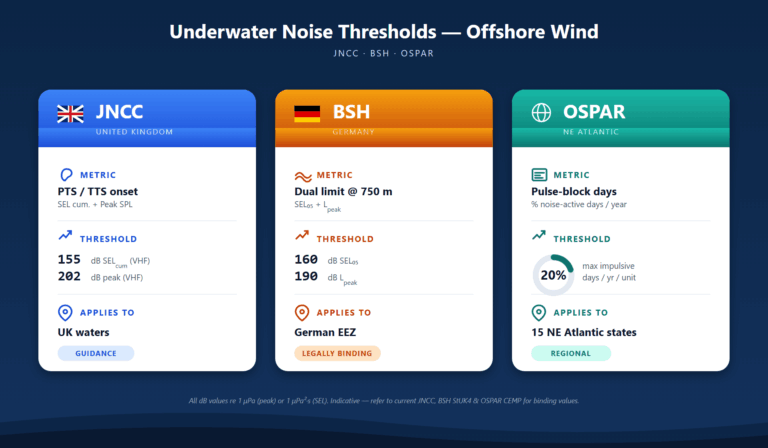
The JNCC framework focuses on behavioural avoidance rather than absolute SEL limits. It assumes that pile driving will exceed PTS thresholds for close-range animals and uses mitigation to prevent that exposure.
The BSH framework (Germany)
The Bundesamt für Seeschifffahrt und Hydrographie (BSH) sets the most quantitative noise thresholds in the offshore wind sector. The German approach is built around absolute limits measured at 750 m from the pile.
Key thresholds, defined in the BSH Standard for Investigation of the Impacts of Offshore Wind Turbines on the Marine Environment (StUK4):
- Single Strike SEL (SEL_ss) ≤ 160 dB re 1 µPa²·s at 750 m.
- Peak Sound Pressure Level (L_peak) ≤ 190 dB re 1 µPa at 750 m.
- Cumulative SEL must be modelled and reported for the full construction window.
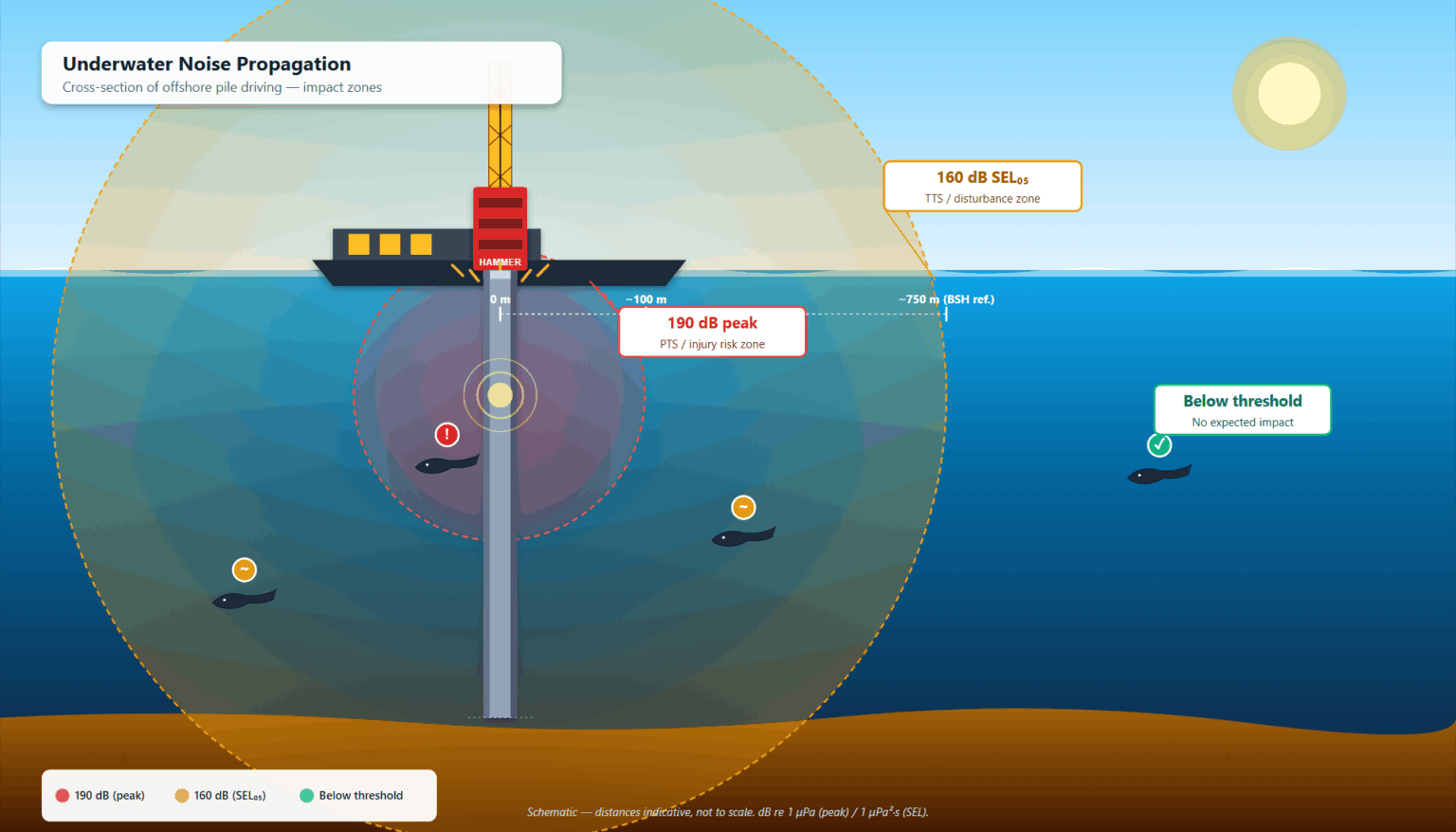
The 160 dB threshold is the operational ceiling for German offshore wind sites. Projects must demonstrate compliance before, during, and after pile driving, using noise measurements taken at multiple distances.
This is a hard limit, not a guideline. Exceeding it triggers regulatory action, including potential stoppage of construction. The BSH framework is the reason why noise mitigation systems are so deeply integrated into German projects: without them, the 160 dB ceiling is unreachable for monopiles above approximately 6 metres in diameter.
The OSPAR framework (North-East Atlantic)
The OSPAR Convention coordinates marine protection across the North-East Atlantic. Its 2024 update of the Coordinated Environmental Monitoring Programme (CEMP) sets shared underwater noise indicators that all contracting parties report against.
OSPAR does not impose hard project-level thresholds. It sets two environmental status indicators:
- Indicator D11C1: spatial and temporal distribution of impulsive noise sources (pile driving, seismic surveys, sonar).
- Indicator D11C2: ambient sound levels in third-octave bands centred on 63 Hz and 125 Hz.
These align with the EU Marine Strategy Framework Directive (MSFD) Descriptor 11, which requires Member States to keep underwater noise at levels that do not adversely affect the marine environment.
OSPAR provides the regional context in which national thresholds (JNCC, BSH and others) operate. A project that complies with national limits may still contribute to a regional cumulative impact that OSPAR tracks at basin scale.
Comparing the three frameworks
| Framework | Geography | Approach | Key threshold |
|---|---|---|---|
| JNCC | United Kingdom | Behavioural mitigation, no hard SEL limit | 500 m mitigation zone, 20-min soft-start |
| BSH | Germany | Hard SEL and L_peak limits at 750 m | SEL_ss ≤ 160 dB, L_peak ≤ 190 dB |
| OSPAR | North-East Atlantic | Regional indicators, basin-scale monitoring | MSFD D11C1 and D11C2 |
In practice, a project operating in multiple jurisdictions complies with the strictest applicable framework. Floating offshore wind projects in the Celtic Sea, for example, often align with BSH-style numerical thresholds even where UK rules would allow a lighter regime, because the cumulative impact assessment makes that the only defensible choice.
What compliance looks like during pile driving
A typical compliance package on a modern offshore wind site combines five elements.
Pre-construction modelling
Acoustic propagation models predict SPL and SEL contours for each pile, accounting for water depth, sediment type, and pile geometry. The model output drives the mitigation plan.
Soft-start
Hammer energy is increased gradually, typically over 20–40 minutes, allowing animals to move out of the mitigation zone before peak hammer energy is reached.
Noise mitigation systems
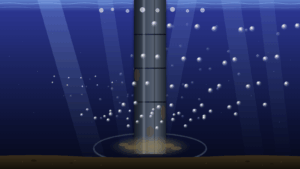
Big-bubble curtains, IHC Noise Mitigation Screens, or hydro sound dampers reduce SEL by 8–20 dB at 750 m. They are mandatory under BSH and increasingly standard under JNCC consents.
Real-time PAM and MMO
Hydrophones and visual observers monitor the mitigation zone continuously. Detection of a protected species in the zone triggers a shutdown or delay.
Post-event reporting
Each piling event is recorded with SEL, L_peak, soft-start log, MMO sightings, and PAM detections. The report is the audit trail for the regulator.
Where Sinay fits
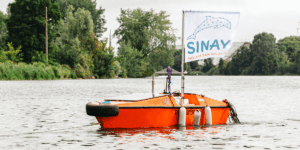
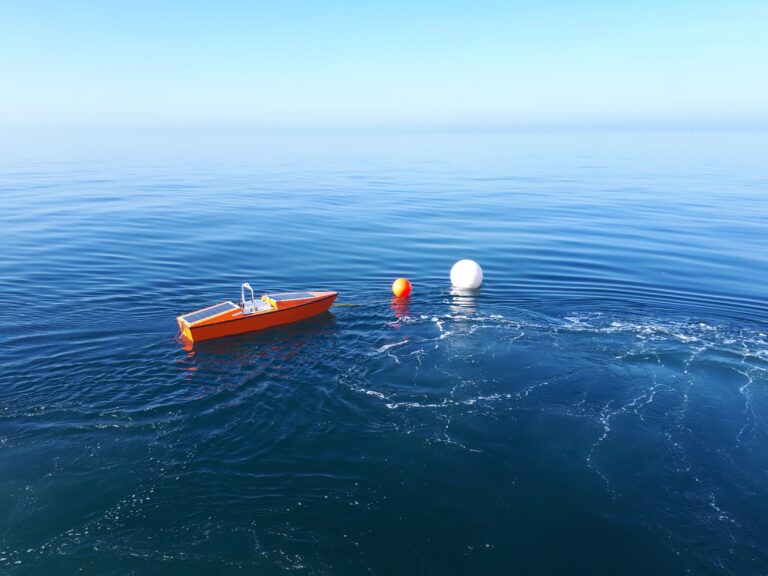
Sinay deploys PAM buoys and noise modelling for offshore wind projects across the North Sea, the Atlantic, and the Mediterranean. The platform combines pre-construction propagation modelling, real-time underwater noise monitoring, and automated reporting aligned with JNCC, BSH, and OSPAR requirements.
The output is a centralised compliance dashboard that captures every piling event, every mitigation action, and every marine mammal interaction in one auditable record.
FAQ
Pile driving is the loudest activity, producing peak sound pressure levels above 220 dB re 1 µPa at the source. Cable laying, vessel traffic, and turbine operation are significantly quieter.
A regulatory limit set by the German BSH agency. Pile driving must not exceed a Single Strike Sound Exposure Level of 160 dB re 1 µPa²·s measured at 750 m from the pile.
A 500 m mitigation zone monitored by Marine Mammal Observers and PAM operators, a pre-piling search of at least 30 minutes, a 20-minute soft-start, and use of Acoustic Deterrent Devices where appropriate.
SPL measures peak sound pressure of a single event. SEL measures the acoustic energy of a sound integrated over time, in dB re 1 µPa²·s. SEL is the standard metric for assessing risk of permanent hearing damage.
Yes. Floating offshore wind uses different foundation types but the regulatory frameworks for underwater noise apply equally. Anchor installation and cable laying also produce noise that must be assessed.