
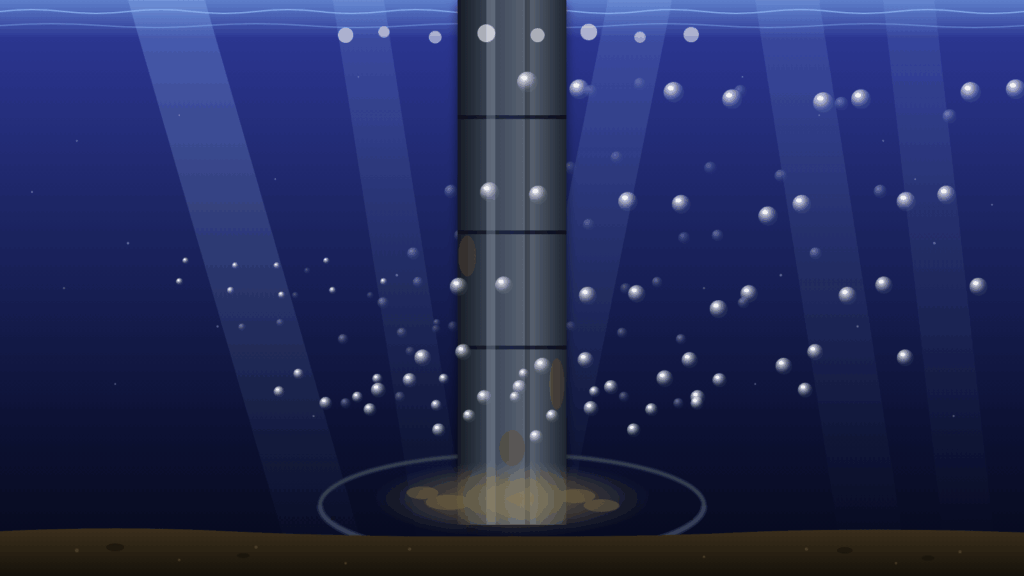
Pile driving an offshore wind monopile is one of the loudest controlled activities at sea. Without noise mitigation, Single Strike Sound Exposure Levels exceed 180 dB re 1 µPa²·s at 750 m for large monopiles, well above regulatory limits in Germany, the Netherlands, and most modern offshore wind jurisdictions.
Three technologies do the heavy lifting on noise reduction: bubble curtains, IHC Noise Mitigation Screens, and real-time Passive Acoustic Monitoring. None replaces the others. Together, they make compliant offshore wind construction possible.
Why pile driving is so loud
A monopile is hammered into the seabed by a hydraulic impact hammer delivering 2,000–6,000 kJ per blow. Each blow sends two acoustic signals into the water: a direct radiation from the pile wall, and a Mach cone caused by the bending wave travelling down the pile. The result is a high-amplitude broadband pulse that propagates kilometres in shallow water.
Three factors drive noise levels:
- Pile diameter. A 10-metre monopile produces roughly 6–8 dB more SEL than a 5-metre pile at the same hammer energy.
- Hammer energy. Doubling hammer energy adds about 3 dB to peak SPL.
- Water depth and sediment. Shallow water and hard sediments propagate noise further than deeper water and soft mud.
For a typical 8-metre monopile driven at 3,500 kJ in 25 m of water, unmitigated SEL at 750 m can exceed 180 dB re 1 µPa²·s. The BSH limit is 160 dB. The mitigation system has to deliver at least 20 dB of broadband reduction to keep the project legal.
Big Bubble Curtains
A Big Bubble Curtain (BBC) consists of a perforated hose laid on the seabed in a ring around the pile, supplied with compressed air from a vessel. Air rises in a column of bubbles that surround the pile, creating an acoustic impedance discontinuity that reflects and scatters sound.
A Double Big Bubble Curtain (DBBC) uses two concentric rings, typically 70 m and 130 m from the pile, for redundancy and additional attenuation.
Typical performance:
- Broadband SEL reduction: 8–14 dB for a single BBC, 12–18 dB for a DBBC.
- Frequency selectivity: best attenuation between 100 Hz and 1 kHz, with reduced effect below 50 Hz.
- Operational depth: routinely used in water up to 40 m.
BBCs are the most cost-effective and most-used mitigation technology in German and Dutch offshore wind. They are flexible, removable, and compatible with any pile geometry. Their main limit is the air supply: a DBBC for a 10 m pile needs compressors delivering 150–250 m³/min for the duration of the strike sequence.
Common failure modes include hose kinks, uneven bubble distribution, and current shear that displaces the bubble column. Good operators run pre-piling acoustic verification to confirm the curtain is working before each pile.
IHC Noise Mitigation Screens
The IHC Noise Mitigation System (NMS) is a near-pile sleeve. A double-walled steel cylinder is lowered around the pile before piling, with a thin water layer and elastomeric damping material between the two walls. The sleeve attenuates noise close to the source rather than along the propagation path.
Typical performance:
- Broadband SEL reduction: 12–17 dB.
- Frequency selectivity: effective across a broader frequency range than BBC, including below 100 Hz.
- Operational depth: limited by sleeve dimensions and vessel handling, typically up to 40 m.
The IHC NMS is the preferred mitigation in projects with strict cumulative impact constraints because it attenuates noise before it enters the water column. It is also more expensive and more vessel-intensive than a BBC, which is why it tends to be combined with a single BBC rather than used alone on large monopiles.
A growing alternative is the Hydro Sound Damper (HSD), a mesh of foam elements deployed around the pile. HSDs offer similar mid-frequency attenuation to a BBC with lower air supply requirements.
Combining mitigation systems
For large monopiles (8 m and above), no single mitigation technology delivers enough reduction. The standard configuration is now a layered system:
- Inner layer: IHC NMS or HSD close to the pile.
- Outer layer: BBC or DBBC further out.
This setup routinely achieves broadband SEL reduction of 17–22 dB, which keeps SEL at 750 m below the BSH 160 dB threshold even for 10 m monopiles.
The layered approach also adds redundancy. If the IHC sleeve has a sealing issue, the BBC still provides a safety margin. If the BBC compressor falters, the IHC sleeve still attenuates close to the source.
Real-time Passive Acoustic Monitoring
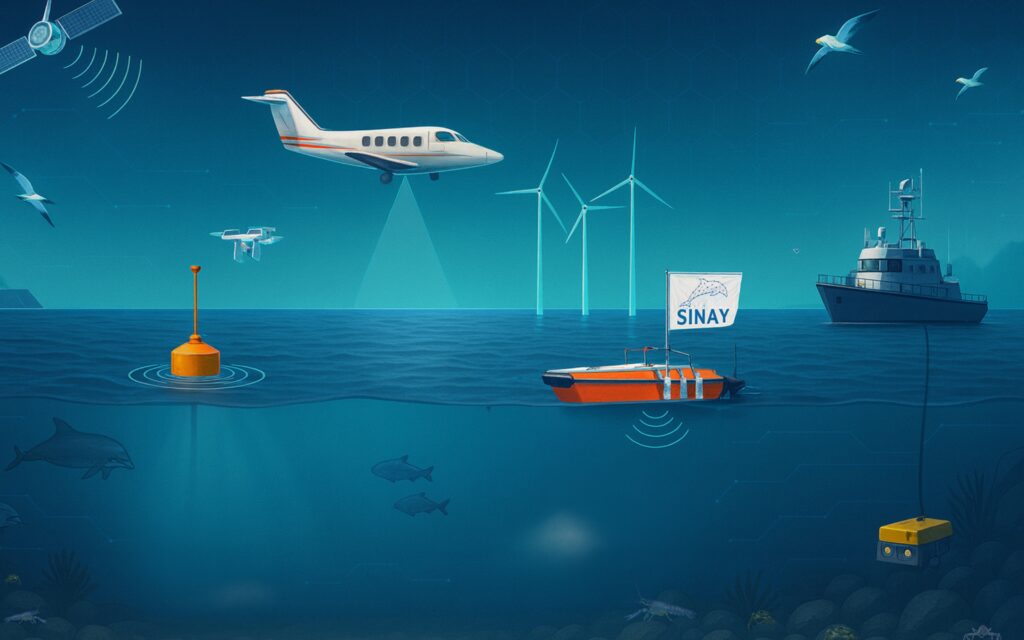
Mitigation systems reduce noise. Passive Acoustic Monitoring (PAM) verifies that they are working and tracks marine mammal presence in real time.
A modern offshore wind PAM array combines three elements:
- Buoys with hydrophones deployed at 750 m, 1,500 m, and 3,000 m from the pile.
- Real-time data link to a monitoring vessel or onshore station, typically over 4G or satellite.
- Automated detection algorithms for marine mammal vocalisations and noise level thresholds.
The system delivers three operational outputs.
Noise compliance verification
SEL and L_peak are measured at each buoy in real time. If thresholds are approached, the project team can adjust hammer energy or pause piling.
Marine mammal detection
Click detectors and broadband detectors identify harbour porpoise, dolphins, and other cetaceans in the mitigation zone. Detection triggers a shutdown or delay under JNCC and BSH protocols.
Auditable record
Every piling event is logged with the noise measurements, detections, and mitigation actions. The record is the evidence package the regulator audits.
PAM is mandatory under most modern offshore wind consents. The 2023 update of the JNCC piling guidelines and the BSH StUK4 standard both require real-time PAM during pile driving.
What a good mitigation plan looks like
A defensible noise mitigation plan covers six elements before construction begins.
- Acoustic propagation modelling for each pile, accounting for hammer energy, water depth, sediment, and mitigation system performance.
- Mitigation system specification: BBC, DBBC, IHC NMS, HSD, or a combination, with vendor-validated attenuation curves.
- Real-time PAM array with hydrophones positioned to verify compliance at regulatory distances.
- Marine mammal observer protocol, with shutdown triggers and decision rules.
- Soft-start procedure, with hammer energy ramp and time-to-full-energy documented.
- Reporting template aligned with JNCC, BSH, OSPAR, or the relevant national regulator.
Each element has to be tied to the others. A BBC with no PAM verification is regulatory exposure. A PAM array with no soft-start protocol is incomplete mitigation. Modern projects integrate all six into a single operational plan.
Where Sinay fits
Sinay provides PAM buoys, real-time noise monitoring, and acoustic modelling for offshore wind projects across the North Sea and the Atlantic. The platform combines pre-construction propagation models with real-time SEL and L_peak measurements, marine mammal detection, and automated reporting aligned with JNCC, BSH, and OSPAR.
For project teams, this turns noise compliance from a reactive risk into a managed operational layer.
FAQ
A single Big Bubble Curtain typically delivers 8–14 dB of broadband SEL reduction. A Double Big Bubble Curtain achieves 12–18 dB depending on configuration, water depth, and currents.
In Germany, the Netherlands, and most modern European offshore wind sites, yes. The BSH 160 dB threshold cannot be met for large monopiles without effective noise mitigation, which usually includes a bubble curtain.
A BBC creates a barrier of rising bubbles around the pile. An IHC NMS is a steel sleeve installed close to the pile with damping material. The BBC works along the propagation path. The IHC NMS works at the source. Large projects typically use both.
A network of hydrophones deployed around the construction site that measures underwater noise and detects marine mammal vocalisations in real time. PAM is used to verify mitigation performance and to trigger shutdowns when protected species are detected in the mitigation zone.
Floating turbines do not require pile driving, but anchor installation and cable laying still produce significant noise. PAM and adapted mitigation strategies apply to those phases.