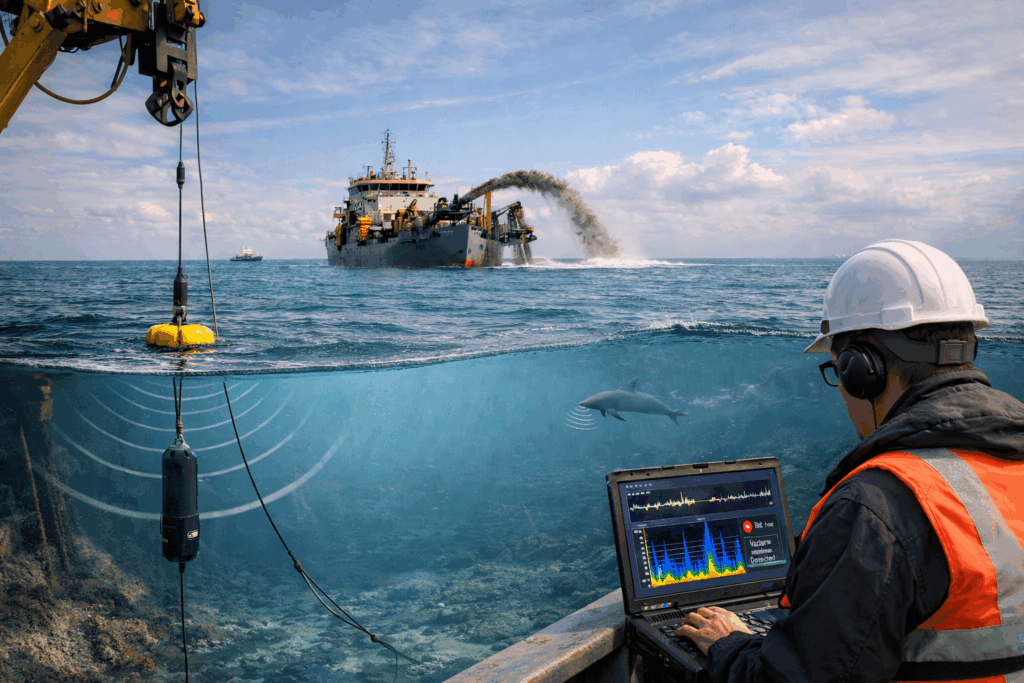
Underwater noise regulations are tightening to safeguard sensitive areas such as Natura 2000 sites and marine mammal habitats. The European Union’s Marine Strategy Framework Directive (MSFD) now mandates that Member States manage harmful anthropogenic noise impacts. While dredging remains vital for navigation and port operations, it generates intense acoustic emissions. Large dredgers frequently exceed source levels of 180 dB re 1 μPa, with propagation extending over several kilometers of ocean. Consequently, companies must demonstrate compliance without compromising operational efficiency. Passive Acoustic Monitoring (PAM) offers a critical solution in this context, enabling adherence to thresholds and the avoidance of penalties through objective, continuous measurement.
Underwater noise and dredging: a growing regulatory challenge
Dredging operations emit underwater noise pollution from multiple simultaneous sources.
Each dredge type exhibits a distinct acoustic signature. Mechanical dredgers generate continuous noise through the operation of cutter heads. Hydraulic models utilize high-power pumps that induce cavitation and high-frequency emissions. Trailing Suction Hopper Dredgers (TSHD) combine these systems with vessel propulsion, further complicating the sound spectrum. Support vessels contribute to this aggregate noise level via propeller cavitation and engine operation. This accumulation elevates ambient noise levels by 15 to 30 dB within project zones.
Marine fauna is directly impacted by these acoustic disturbances. Mammals and fish are observed modifying behaviors, abandoning habitats, or deviating from migratory routes. Furthermore, noise masks vital communication signals. Physiological stress increases, as evidenced by elevated cortisol levels quantified in laboratory settings. Fish spawning grounds are particularly vulnerable, as acoustic disturbance threatens reproductive success and ecosystem health. The journal Aquatic Conservation: Marine and Freshwater extensively documents these deleterious and harmful effects across various ocean species.
In response to these findings, regulatory bodies enforce stringent underwater constraints. Maximum permissible acoustic levels are now contingent upon habitat sensitivity and seasonal variables. Dredging permits increasingly stipulate precise conditions, based on breeding windows and specific operating hour restrictions. Consequently, acoustic monitoring is frequently mandated. The European Commission advocates for measures that balance economic viability with ecological preservation of the ocean. Furthermore, the Habitats Directive mandates site-specific assessments for Natura 2000 areas to guarantee the safeguarding of protected species.
Theoretical modeling and spot checks no longer suffice to guarantee compliance. Authorities demand continuous underwater, empirical evidence throughout the project lifecycle. Concurrently, NGOs and stakeholders scrutinize operations, demanding full transparency regarding acoustic impacts and the efficacy of mitigation measures. This stringent regulatory landscape compels industry adaptation. The objective has shifted from achieving minimum compliance to adopting proactive management strategies that demonstrate tangible environmental protection for the planet.
Passive acoustic monitoring (PAM): from regulatory requirement to operational tool
Passive Acoustic Monitoring transforms this regulatory constraint into a management asset. This monitoring tech deploys hydrophones to continuously monitor the underwater environment, capturing the complete soundscape—an aggregation of ambient noise and anthropogenic activity.
In contrast to snapshot measurements, PAM provides comprehensive visibility into operational cycles. Modern systems utilize sampling rates exceeding 40 kHz. This sensitivity captures the full spectrum, ranging from low-frequency machinery rumble to ocean marine mammal ultrasonics. Data collection architecture is scalable to project requirements: autonomous units record for weeks, while cabled systems transmit real-time intelligence for immediate decision-making.
This methodology replaces theoretical predictions with ground truth data and science. It accounts for unique site-specific physical factors, such as bathymetry, sediment composition, and water column stratification. These variables alter sound propagation in ways often unpredictable by mathematical models. Furthermore, the technology isolates dredging noise from surrounding maritime traffic. Finally, it analyzes acoustic variations at every phase—from mobilization to active dredging—to optimize intervention strategies.
Verification via PAM systematizes regulatory adherence. The system benchmarks underwater levels against established thresholds in real time, triggering alerts as limits are approached. Continuous recording generates tangible evidence throughout the project duration. This approach satisfies the fundamental environmental management principle: “what is not documented is not done.” Automated reporting extracts key metrics, such as compliance percentage and exceedance frequency. This objective data streamlines regulatory submissions, mitigates litigation risks, and demonstrates corporate due diligence.
Ocean acoustic trend analysis provides direct insights into equipment condition. An anomalous acoustic signature frequently signals mechanical distress prior to actual failure. Furthermore, cross-vessel benchmarking helps identify the quietest operational methodologies. By integrating this data with dredge positioning, the system generates acoustic maps that pinpoint noise hotspots. Monitoring thus shifts from a passive bureaucratic formality to an active, strategic management asset.
A dredging company’s journey: implementing PAM for regulatory compliance
Project success hinges on meticulous preparation prior to any in-water works and operations. The contractor must first identify sensitive receptors and legal constraints.
Phase 1: Pre-project assessment and planning
The process begins with precise biological baseline surveys. These inventories catalog marine mammals, spawning grounds, and deep-water protected habitats. The team then analyzes the permit to extract applicable noise limits. These thresholds frequently exhibit spatial, seasonal, or diurnal variability. Dialogue is then initiated with environmental regulators and NGOs. This consultation establishes monitoring expectations and reporting protocols. This foundational step defines the technical specifications for the deployed PAM system.
Phase 2: System design and configuration
System architecture is subsequently tailored to the site’s specific underwater acoustic characteristics. Hydrophone selection is directly contingent upon the target species present. For instance, baleen whales require sensors with a flat frequency response in the sub-100 Hz range. Spatial configuration must balance optimal coverage with technical feasibility. Typically, an array of 2 to 4 hydrophones is deployed around the operational perimeter. This arrangement captures near-field noise while maintaining communications range. Hardware selection also varies by mission profile: fixed installations suit stationary dredging, whereas mobile buoys track dynamic operations such as channel deepening.
Phase 3: Deployment and Integration
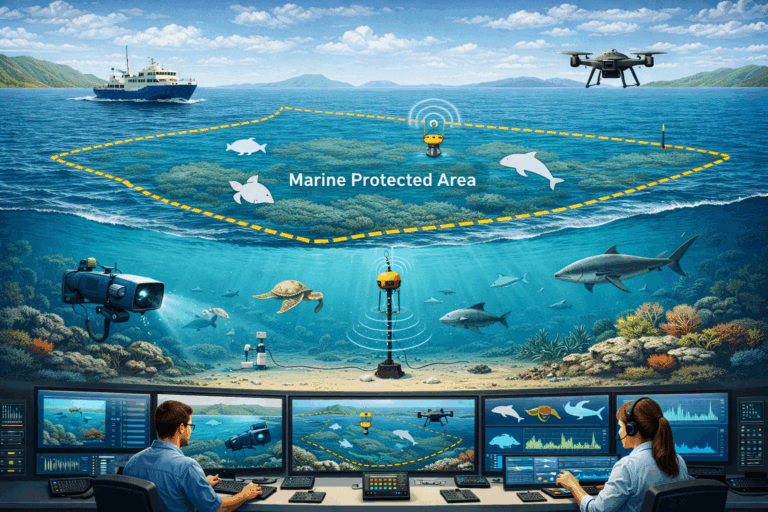
Physical installation demands close coordination with dredging crews. Seafloor-mounted hydrophones require stable moorings to prevent sediment burial or displacement. Cable routing must meticulously avoid dredge tracks and anchorage zones. Communication reliability is critical in this harsh sea environment, whether achieved via hardwiring, acoustic modems, or cellular transmission. Once hardware is positioned, reference sound sources enable precise sensor calibration. Finally, integrating the system with dredge controls allows for immediate, automated responses to acoustic conditions.
Phase 4: Operational integration and active management
Data integration transforms monitoring from a passive observation into an active operational control tool. On the bridge, the crew monitors noise levels alongside standard working and navigation instruments. Automated alerts warn of imminent exceedances, allowing for immediate reaction.
Protocols are precise: reducing suction pressure by 20% lowers noise output by 3 to 5 dB. Increasing the standoff distance from sensitive zones by 200 meters yields an additional 2 to 3 dB reduction. Scheduling also plays a key role, reserving high-noise ocean activities for periods of lowest biological sensitivity. These graduated adjustments guarantee compliance without compromising quality and productivity.
Phase 5: reporting and post-project analysis
The final report converts months of monitoring into an irrefutable compliance record. It synthesizes statistics such as means and distributions to illustrate actual ocean site conditions. Temporal analysis highlights diurnal cycles, while spatial mapping visualizes sound exposure levels in adjacent habitats.
Every exceedance is documented with its duration, environmental context, and the crew’s remedial response. This comprehensive document satisfies regulatory requirements and serves as a foundation for refining strategies on future projects.
Benefits beyond compliance: risk reduction and social acceptability
Ocean acoustic monitoring offers significantly more than mere legal validation. It serves as a major strategic lever to secure operations and mitigate regulatory exposure.
Mitigating regulatory and project risk
Documented noise management demonstrates operator due diligence. This transparency encourages regulatory leniency regarding minor exceedances. Crucially, real-time responsiveness prevents protracted non-compliance and severe sanctions. This proactive stance contrasts sharply with legacy methodologies, which were often reactive and triggered retrospectively by complaints.
Consequently, equipped contractors experience fewer work stoppages and conflicts. Operational uncertainty is reduced, as operators are assured that environmental factors will not precipitate sudden project shutdowns. Financial institutions and underwriters value this risk mastery, occasionally resulting in reduced premiums or bonding requirements. Finally, it représente a decisive commercial asset; clients increasingly prioritize contractors with impeccable track records for sensitive projects.
Enhancing social license and corporate reputation
The positive impact extends to local communities. Transparent monitoring, featuring anonymized public reporting, fosters trust among NGOs and local stakeholders. Empirical data replaces abstract fears with measurable evidence of protection. At the corporate level, acoustic monitoring substantiates sustainability reporting. It tangibly enhances corporate reputation among investors focused on Environmental, Social, and Governance (ESG) criteria.
Tangible economic and operational implications
Economic benefits are equally distinct. Operational stability facilitates precise resource planning, thereby circumventing the exorbitant costs and delays associated with unplanned stoppages. The enterprise hedges against fines that can escalate to hundreds of thousands of euros. Furthermore, the analysis of historical data optimizes future tendering strategies and bolsters competitiveness. The initial cost of monitoring remains modest—typically ranging between 1% and 3% of the total works budget. This capital allocation yields a rapid return on investment through risk mitigation and the acquisition of operational intelligence.
Sinay as a trusted partner for PAM in regulated marine projects
We engineer digital solutions for real-time underwater noise monitoring. Our mission is to assist dredging and maritime construction firms in achieving rigorous compliance with environmental regulations.
An integrated approach to environmental intelligence
Our strategy embeds acoustic monitoring within comprehensive environmental intelligence platforms. Effective noise management requires a holistic perspective, necessitating an understanding of the interplay between operational activities, marine life, and regulatory frameworks. We also incorporate oceanographic conditions, as these factors directly influence sound propagation in the ocean.
Platform capabilities and data integration
Our platform is specifically engineered to address the operational constraints of dredging. It centralizes data from multiple hydrophone arrays for automated analysis. The system benchmarks sound levels against established thresholds, triggering alerts as required.
Real-time visualization displays current sound pressure levels and recent trends, clearly indicating remaining safety margins relative to regulatory limits. Data archiving subsequently facilitates compliance reporting and cross-project benchmarking.
Finally, dashboards are customizable by user role. Bridge operators utilize simplified indicators, while environmental coordinators access granular metrics for better working protocols. Conversely, regulatory reporting modules generate comprehensive statistical overviews.
The integration of external data sources enriches operational decision-making. AIS vessel tracking correlates noise events with specific activities, isolating the dredge’s acoustic signature from surrounding maritime traffic. Meteorological data provides essential context: an acoustic spike occurring during a storm indicates a natural, rather than industrial, origin.
We also integrate marine mammal observations to assess risks in real time. Acoustic maps overlay protected area boundaries to flag proximity to sensitive deep zones. This data fusion transforms simple acoustic measurement into comprehensive situational awareness.
A collaborative partnership for adaptive management
Our support transcends mere technology provision, evolving into a comprehensive science-based methodological collaboration. We collaboratively define monitoring configurations tailored to project scale and species sensitivity. We select precise indicators designed to satisfy compliance mandates and provide stakeholder assurance. Rigorous Quality Assurance (QA) protocols guarantee data integrity throughout the project lifecycle. Subsequently, we integrate this intelligence into an adaptive management framework to protect biological health. This continuous learning cycle transforms raw data collection into immediately actionable intelligence for operational optimization.
This partnership delivers tangible value to industrial and port operators. Documented noise management bolsters confidence in regulatory compliance. Real-time responsiveness drastically mitigates operational risks and acquired intelligence enables efficiency optimization even under ecological constraints. Furthermore, evidentiary transparency facilitates constructive dialogue with external observers. Our methodology is replicable across multiple jurisdictions, facilitating practice harmonization and building robust environmental competency capable of satisfying diverse regulatory frameworks for marine ecosystems.
Conclusion
Dredging contractors can now guarantee compliance through systematic Passive Acoustic Monitoring (PAM). This approach transforms environmental requirements into effective management assets. The synergy of cutting-edge tech, robust protocols, and real-time analytics ensures objective verification while optimizing operations.
The benefits extend significantly beyond the legal scope, encompassing risk mitigation, enhanced social standing, and a sustainable competitive advantage. PAM has established itself as the standard for maritime construction in sensitive ocean zones. Through collaboration between industrial operators, regulators, and technology experts, the sector can now reconcile project performance with ecosystem protection of marine life with complete confidence.
FAQ
A dredging company complies with underwater noise regulations by monitoring sound levels generated during operations and ensuring they remain below regulatory thresholds. This is achieved through continuous acoustic measurements, reporting, and the implementation of mitigation measures when required.
Passive Acoustic Monitoring (PAM) allows dredging operators to measure underwater noise in real time and detect sensitive marine species, such as marine mammals. PAM provides objective data to demonstrate regulatory compliance and supports adaptive decision-making during operations.
No. Beyond regulatory compliance, PAM helps reduce environmental risks, limit project delays, and improve transparency with regulators and stakeholders. It also contributes to better environmental impact assessments and long-term monitoring strategies.
Maritime Applications