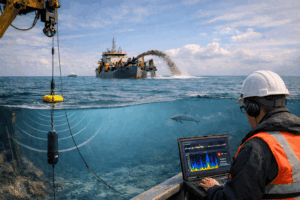

Offshore wind energy has emerged as a cornerstone of the global energy transition. With European capacity reaching 30 GW in 2023, WindEurope projects this figure will surpass 110 GW by 2030.
However, construction phases specifically pile driving operations can generate source levels exceeding 200 dB re 1 μPa, propagating across tens of kilometers. These noise emissions pose significant risks to cetaceans and pinnipeds, which rely on acoustic communication, echolocation, and acute hearing for survival. Potential impacts range from behavioral disturbance and communication masking to physical auditory injury.
Consequently, offshore wind developers face the challenge of balancing renewable energy expansion with marine biodiversity conservation. This analysis explores how real-time acoustic monitoring facilitates cetacean detection, Exclusion Zone (EZ) management, and operational adjustments to safeguard marine mammals during construction activities.
Offshore wind construction and underwater noise: What is at stake for marine mammals ?
Offshore wind construction involves operations characterized by high-intensity acoustic emissions. Chief among these is pile driving, which generates impulsive sounds with peak pressure levels reaching 190 to 220 dB re 1 μPa. These intense pulses propagate through the water column with significantly greater efficiency than in air, impacting marine life across extensive areas. Furthermore, construction vessels contribute to continuous noise via propeller cavitation and engine operation, elevating ambient noise levels by 10 to 20 dB.
Marine mammals exhibit acute vulnerability to anthropogenic noise due to their biological reliance on acoustic systems. While cetaceans utilize species-specific vocalizations, baleen whales generate low-frequency calls for long-range communication, whereas toothed whales employ high-frequency echolocation for navigation and prey detection. Excessive noise masks these signals, reducing effective communication ranges and compromising foraging efficiency.
Research published in Marine Ecology Progress Series documents behavioral responses ranging from temporary habitat displacement and altered diving patterns to elevated stress hormone levels. At extreme exposure levels, particularly during pile driving, marine mammals face the risk of Temporary or Permanent Threshold Shifts (TTS/PTS) in auditory sensitivity, potentially compromising survival.
Regulatory frameworks strictly mandate the mitigation and monitoring of construction noise. The European Union’s Marine Strategy Framework Directive (MSFD) requires Member States to achieve Good Environmental Status (GES), which includes maintaining appropriate underwater noise levels.
Consequently, national authorities impose project-specific conditions, including maximum noise thresholds, mandatory monitoring of protected species, and seasonal restrictions during sensitive periods such as breeding or migration. Environmental Impact Assessments (EIAs) must demonstrate that projects minimize harm through the application of Best Available Techniques (BAT). These regulatory requirements create legal obligations for developers to implement monitoring systems capable of detecting marine mammal presence and enabling immediate protective responses.
Real-time monitoring has become indispensable for compliance and risk management. Unlike post-construction assessments that reveal impacts retrospectively, real-time systems enable immediate protective actions when marine mammals enter construction zones.
Furthermore, data traceability facilitates the demonstration of regulatory compliance by documenting detection events, operational responses, and mitigation efficacy. The shift toward real-time approaches reflects the recognition that prevention takes precedence over retrospective impact quantification for the protection of vulnerable species.
Principles of real-time acoustic monitoring for marine mammals
Real-time acoustic monitoring utilizes hydrophones—underwater microphones—that continuously record marine soundscapes.
Deployment configurations vary based on project requirements: fixed seafloor installations, moored buoys, or cabled observatory networks enable permanent monitoring throughout construction phases. Hydrophones measure Sound Pressure Levels (SPL) across frequencies relevant to marine mammal hearing, typically ranging from 10 Hz to 160 kHz. This bandwidth encompasses the infrasonic calls of baleen whales up to the ultrasonic echolocation of odontocetes. High-sensitivity instrumentation detects faint biological signals amidst construction noise, featuring dynamic ranges exceeding 100 dB to accommodate both quiet biological sounds and high-intensity pile driving.
Automated detection and data processing
Marine mammal detection relies on the automated recognition of species-specific vocalizations. Cetaceans produce characteristic acoustic signatures—sperm whale clicks, narrow-band harbor porpoise clicks, bottlenose dolphin whistles, and fin whale pulses—enabling species identification from recordings.
Pattern recognition algorithms analyze spectrograms to identify time-frequency patterns matching reference libraries. Machine Learning classifiers, trained on thousands of annotated calls, distinguish target species from background noise and other biological sounds. Detection algorithms operate continuously to process inbound audio streams, flagging potential marine mammal presence within seconds.
Distinguishing biological signals from industrial noise requires sophisticated signal processing. Construction activities generate broadband energy that potentially masks marine mammal vocalizations. Adaptive filtering techniques are employed to suppress stationary noise components while preserving transient biological signals.
Frequency-specific processing targets bands where specific species vocalize, reducing noise interference from other frequency ranges. Time-domain analysis identifies the impulsive characteristics of echolocation clicks, distinguishing them from continuous machinery noise. Collectively, these processing chains achieve detection sensitivities capable of identifying marine mammals even during moderate construction activity.
Data transmission and expert validation
The data transmission infrastructure routes acoustic intelligence from marine sensors to shore-based monitoring centers or vessel-based stations. Subsea cables provide reliable, high-bandwidth connections for cabled hydrophone networks. Conversely, autonomous buoy systems utilize satellite or cellular communication to transmit compressed data at intervals ranging from real-time to hourly, contingent upon bandwidth availability. Edge computing capabilities facilitate onboard processing, transmitting detection alerts rather than continuous raw audio. This architecture minimizes bandwidth requirements while maintaining real-time response capabilities.
Bioacousticians provide essential expertise throughout the lifecycle of monitoring programs. Initial deployment requires rigorous calibration to ensure accurate sound level measurements and verification of spatial coverage. During operations, experts validate automated detections, discriminating between true marine mammal calls and false positives generated by vessel noise, meteorological conditions, or electronic interference. Periodic data quality reviews confirm system performance, while post-construction analysis synthesizes results into comprehensive reports documenting marine mammal presence patterns and construction impact assessments.
From detection to action: exclusion zones, alerts, and operational protocols
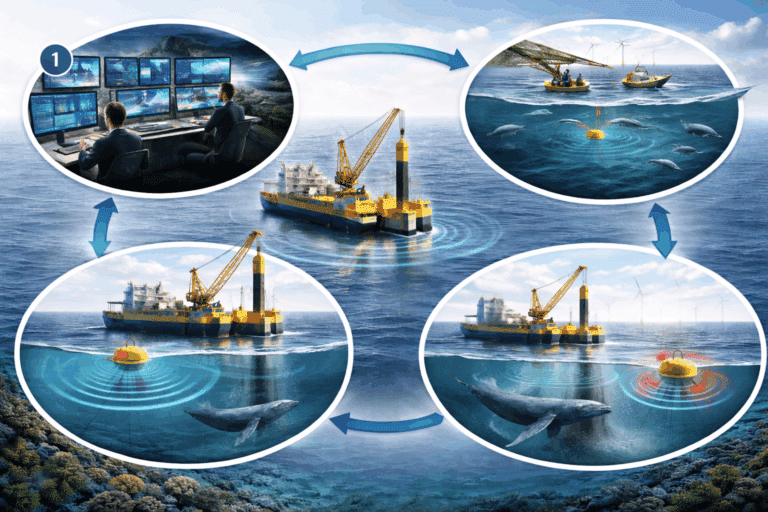
Acoustic Exclusion Zones establish protective buffers around construction activities where marine mammal presence triggers immediate operational modifications.
Zone dimensions are contingent upon species sensitivity, sound propagation modeling, and regulatory requirements. Typical configurations include a 500-meter mitigation zone, where any marine mammal detection mandates immediate action, and a 1,000-meter monitoring zone providing early warning of approaching animals. Threshold definitions account for species-specific vulnerabilities; for instance, harbor porpoises require protection at lower exposure levels than large cetacean species due to higher auditory sensitivity within pile-driving frequency ranges.
Operational alert protocols translate acoustic detections into protective protocols. When monitoring systems identify marine mammals within exclusion zones, automated notifications are immediately dispatched to construction teams via SMS, radio, or dedicated alert platforms. Depending on detection proximity and species identification, responses include the immediate cessation of pile driving, power reduction to soft-start levels to allow animals to vacate the area voluntarily, or construction delays until animals have moved beyond exclusion boundaries. In practice, decision matrices established during project planning define specific responses to various detection scenarios, ensuring consistent and defensible protective actions.
Mitigation measures in practice
During the construction of the Borssele III & IV OW farm in the Netherlands, real-time acoustic monitoring detected harbor porpoises within exclusion zones on 47 occasions over a six-month period. Each detection triggered an immediate pile-driving shutdown, resulting in an average delay of 23 minutes until the animals exited the protected zones. Post-construction analysis indicated that no pile driving occurred while porpoises were in proximity, validating the efficacy of responsive monitoring in safeguarding marine life.
Acoustic monitoring is integrated with complementary mitigation strategies to establish a layered protection framework. Marine Mammal Observers (MMOs) provide visual surveillance that complements acoustic detection, proving particularly effective during daylight hours and favorable weather conditions. “Soft-start” protocols gradually ramp up pile-driving intensity over a 20-to-30-minute window, allowing marine mammals to detect the disturbance and vacate construction zones prior to full-power operations. Bubble curtains—compressed air systems that create barrier walls around the pile-driving site—attenuate sound propagation by 10 to 20 dB, thereby reducing impact radii. Additionally, seasonal restrictions preclude construction during critical biological windows—such as breeding, calving, or migration seasons—when marine mammal density peaks within project areas.
A systematic workflow for construction phases
Construction phase workflows systematically integrate monitoring protocols. The pre-construction phase establishes acoustic baselines, documenting marine mammal presence and ambient noise levels prior to the commencement of operations. During construction, continuous monitoring generates daily reports summarizing detections, alert events, and operational responses. Real-time dashboards enable environmental managers to track compliance and identify patterns requiring managerial intervention. Finally, post-construction monitoring assesses whether marine mammals return to project areas and if behavioral patterns recover, informing adaptive management strategies for future developments.
A reproducible methodology: technology, protocols, and KPIs
Standardized technological components facilitate the replication of this methodology across diverse projects and regions.
Hydrophone arrays typically consist of 3 to 6 stations positioned around construction sites, providing overlapping coverage to ensure comprehensive detection capabilities. Instrumented buoys integrate hydrophones, meteorological sensors, and power systems capable of supporting autonomous operation over several months. Real-time communication systems transmit data to centralized platforms where automated processing generates detection alerts and compliance reports. Technology selection balances performance requirements, environmental durability, and project budgets, offering solutions scalable from small demonstration projects to large commercial installations.
Implementation protocols establish consistent Standard Operating Procedures (SOPs). Species-specific threshold settings define alert criteria tailored to local marine mammal communities; for instance, North Sea projects prioritize harbor porpoise detection, whereas Mediterranean developments focus on dolphin species. Monitoring timelines span pre-construction baseline establishment, active construction phase monitoring, and post-construction impact assessment, creating comprehensive datasets that document project effects. Documentation protocols mandate the detailed recording of all detection events, operational responses, response latencies, and work resumption timelines, thereby creating audit trails that demonstrate regulatory compliance.
Quantifying efficacy via KPIs and case studies
Key Performance Indicators (KPIs) quantify monitoring program efficacy and construction impacts. Detection metrics include total hours of marine mammal presence within monitoring zones, observed species diversity, and temporal patterns revealing diurnal or seasonal variability. Operational metrics quantify alert frequency, cumulative construction delay durations, and response times measured from detection to operational modification. Spatial analysis assesses whether marine mammals exhibit avoidance behavior toward construction zones or maintain presence despite on-site activities. Collectively, these quantitative metrics support adaptive management, regulatory reporting, and knowledge transfer to subsequent projects.
Creating value beyond regulatory compliance
Stakeholder value extends beyond regulatory compliance to encompass the social license to operate and continuous improvement. Transparent reporting that demonstrates proactive marine mammal protection enhances public acceptance of marine wind development.
Furthermore, the quantitative documentation of detection patterns and operational responses provides evidence addressing NGO concerns regarding industrial impacts on marine life. Over time, data accumulated across multiple projects reveals best practices and identifies technological improvements. This advances industry-wide capabilities for biodiversity compatibility.
Sinay’s role: enabling real-time acoustic monitoring for offshore wind
Sinay develops and operates digital solutions to monitor underwater noise in real time, assisting offshore wind developers in protecting marine life.
Our approach integrates acoustic monitoring within comprehensive environmental intelligence platforms. We recognize that effective marine mammal protection requires understanding the interactions between biological presence, construction activities, oceanographic conditions, and regulatory requirements. By synthesizing diverse data sources, we enable evidence-based decision-making. This facilitates an optimal balance between project execution and environmental stewardship.
Our platform capabilities are specifically engineered to meet marine wind monitoring requirements. The aggregation of acoustic data from multiple hydrophone stations feeds automated processing pipelines that apply detection algorithms, classification models, and sound level calculations.
Real-time visualization displays current acoustic conditions, recent marine mammal detections, and alert statuses. These are accessible to construction managers and environmental coordinators via intuitive interfaces. Concurrently, alert generation systems deliver notifications via multiple channels—email, SMS, and radio integration—to ensure that critical intelligence reaches decision-makers immediately, regardless of location.
Furthermore, integration with complementary maritime data enhances situational awareness and operational planning. Metocean hindcasts inform construction scheduling by identifying weather windows. This minimizes both construction delays and marine mammal disturbance through efficient operations.
AIS vessel tracking correlates support vessel traffic with acoustic conditions, enabling the distinction between pile-driving noise and vessel contributions. Environmental sensitivity mapping aggregates diverse habitat zones—including migration corridors and protected areas—to contextualize acoustic detections within broader ecological frameworks.
We partnered with an offshore wind developer in the North Sea to implement acoustic monitoring on an 800 MW project. Our integrated platform combined hydrophone data, meteorological forecasts, construction schedules, and marine mammal distribution models.
Predictive analytics identified optimal construction windows where the probability of marine mammal presence was lowest. This allowed for proactive operational scheduling and the reduction of potential conflicts. Over the construction period, this approach reduced marine mammal detection events by 31% compared to prior project phases that relied solely on reactive monitoring.
Conclusion
Offshore wind energy and marine mammal protection are compatible objectives when construction noise is actively monitored and managed. Real-time acoustic monitoring has evolved from an experimental approach to an essential compliance tool that enables cetacean detection, the enforcement of Exclusion Zones, and operational modifications that prevent harm.
The replicability of this methodology across projects and regions supports systematic protection as offshore wind expands globally. We remain committed to advancing acoustic monitoring capabilities by providing platforms that transform underwater sound into actionable environmental intelligence.
FAQ
Offshore wind construction activities, particularly pile driving, generate intense underwater noise that can disturb marine mammals. These sounds may cause behavioral changes, temporary or permanent hearing damage, displacement from feeding or breeding areas, and increased stress levels, especially for sensitive species such as whales, dolphins, and porpoises.
Real-time acoustic monitoring relies on passive acoustic monitoring (PAM) systems that continuously listen to underwater soundscapes. These systems detect and identify marine mammal vocalizations in near real time, allowing operators to assess the presence of protected species during offshore construction activities.
By detecting marine mammals as they enter predefined safety zones, real-time acoustic monitoring enables construction teams to:
Delay or stop noisy operations when animals are present
Adapt construction schedules dynamically
Reduce the risk of harmful sound exposure
This proactive approach significantly improves mitigation effectiveness compared to visual observation alone.
Maritime Applications