
Onboard observers and Remote Electronic Monitoring (REM) are the two main methods used to collect fisheries data at sea. Both are legitimate, both have decades of regulatory precedent, and both have well-known limits. The question for most national programs in 2026 is not which method to choose but how to combine them.
This article breaks down the cost, coverage, accuracy, and operational trade-offs between observers and REM, then explains why hybrid programs have become the dominant model.
You may also like:
What onboard observers do well
An onboard observer is a trained biologist or fisheries technician who joins a vessel for one or several trips. They count catch, identify species, sample biological material, witness interactions with marine mammals or seabirds, and verify gear configuration.
Observers excel where REM has limits.
- They can handle and measure specimens directly, taking morphometric data, otoliths for ageing, or genetic samples.
- They can identify ambiguous species that look similar on video but differ in subtle features.
- They can interview the skipper and record the qualitative context that video does not capture.
- They can observe behaviour out of camera range, including activity below deck or during net mending.
For research-grade data on stock structure, observers remain irreplaceable.
Why compliance is hard to prove
The landing obligation is one of the most ambitious pieces of fisheries legislation in the world. Compliance, however, is structurally difficult to verify. Three reasons explain the gap.
Observers cover too few trips. Most national programs cover between 2% and 10% of fishing days, depending on the métier. That coverage is too thin to detect illegal discarding with statistical confidence, especially on small vessels operating in remote zones.
Self-reported logbooks are easy to underreport. Skippers fill in logbooks and electronic reporting systems, but no external check verifies what was actually caught versus what was declared. Audit comparisons regularly show divergence between reported catch and stock assessment models.
Discarding is fast and unobserved. A trawler can sort and discard several tons of fish in minutes. Without continuous, time-stamped video, regulators have no way to reconstruct what happened on deck after the haul.
The result is a well-documented enforcement gap. ICES advice notes recurrent issues with discard underreporting, and the European Court of Auditors Special Report 08/2017 concluded that the landing obligation had not achieved its objectives, citing a lack of monitoring as a primary cause.
Where the observer model breaks down
Three structural issues limit observer programs.
Coverage stays low. Most national programs cover between 2% and 10% of fishing days. Pushing that figure higher means hiring more observers, paying for their travel and accommodation, and finding berths on vessels that often have no spare bunk. Some métiers, especially small-scale coastal vessels, cannot host an observer at all.
Costs grow linearly with coverage. Every additional percentage point of observer coverage costs roughly the same as the previous one. There is no economy of scale, because the bottleneck is people, not technology.
Observer effect. When a trained observer is on board, fishing behaviour tends to change. Discarding drops, gear configuration moves toward compliance. The data collected is not always representative of normal operations.
Safety and welfare risks. Observers spend days or weeks at sea on commercial vessels, sometimes in remote areas with no easy evacuation route. Programs face genuine duty-of-care obligations that limit how aggressively coverage can scale.
What REM does well
A Remote Electronic Monitoring system replaces the observer with a fixed installation: cameras, GPS, hauler sensors, and onboard storage. The footage is reviewed later, either onshore or remotely.
REM addresses observer limits directly.
Full coverage is operationally feasible. Once cameras are installed, every haul on every trip is recorded. Programs like OBSCAMe in France run for years at 100% coverage of equipped vessels.
Cost scales sublinearly. Hardware and installation are one-off. Data review is recurring, but AI pre-screening reduces the human time needed per hour of footage by a factor of 5 to 20, depending on the gear and the event rate.
No observer effect. Skippers adjust to cameras within a few trips. After that, behaviour normalises and the data reflects routine operations.
Permanent evidence. REM footage is time-stamped, vessel-linked, and stored. A regulator can revisit a haul months later. An observer’s notebook offers no such audit trail.
Where REM has limits
REM is not a drop-in replacement for observers.
No physical sampling. Cameras cannot weigh a fish, take an otolith, or run a DNA test. For biological research that needs specimens, observers are still required.
Species identification has thresholds. Some species pairs (for example, certain skates or flatfish) cannot be distinguished reliably on video alone. Resolution and angle constraints matter.
Behind-the-camera blind spots. If a catch is processed below deck or thrown back from a position outside camera coverage, REM will miss it. Camera placement and protocol design are critical.
Cold-chain dependency for hardware. Saltwater, mechanical vibration, and rough weather are hard on installed equipment. Programs need a maintenance schedule and a hardware fleet management process.
Cost comparison
Public REM trials in the EU and North America converge on broadly similar figures. The following ranges are typical across pilots published between 2018 and 2024.
Item | Onboard observer | REM |
Coverage achievable | 2–15% of sea days | Up to 100% of equipped vessels |
Cost per sea day (full coverage equivalent) | €600–€1,200 | €80–€250 |
Hardware capex per vessel | Not applicable | €15k–€40k |
Annual data processing cost per vessel | Not applicable | €5k–€15k |
Behavioural representativeness | Compromised by observer effect | High |
Biological sampling | Yes | No |
Regulatory audit trail | Notebook + report | Time-stamped video |
Once the program reaches 15–20% effective coverage, REM is consistently cheaper per sea day than observers, by a factor of 3 to 8 depending on the métier.
Why hybrid is the default in 2026
Most modern programs no longer choose between observers and REM. They run both.
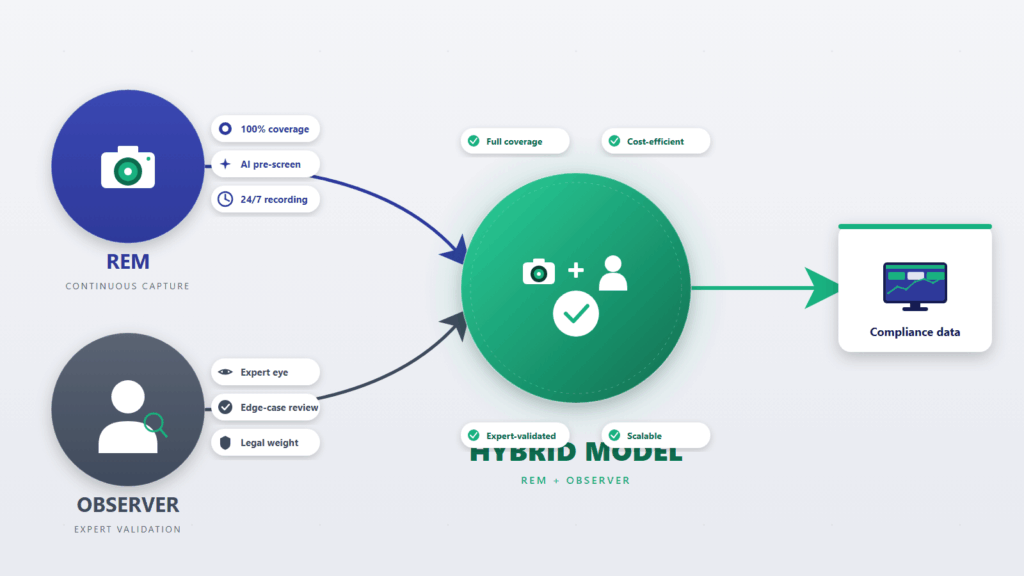
A typical hybrid setup uses REM for high coverage of compliance-related events (catch composition, discards, bycatch) and uses observers on a smaller share of trips to collect biological samples and ground-truth REM data. AI pre-screens the video, observers validate the flagged events, and the same dataset feeds the regulator, the stock assessor, and the operator.
Three programs illustrate the pattern.
OBSCAMe (France) combines REM on 110+ vessels with periodic observer trips for biological sampling and protocol calibration. The hybrid model has been running since the late 2010s with multi-year continuity.
CEFAS (United Kingdom) runs REM on around 20 vessels to monitor wildlife interactions, with observers focused on fish stock sampling.
Pacific Whiting fishery (USA, NOAA) transitioned from 100% observer coverage to REM-dominated coverage in 2020, with observers retained for biological sampling. The shift cut monitoring cost by more than 40% while maintaining data quality.
What this means for program managers
If you are designing or scaling a national fisheries monitoring program, the cost-benefit calculus has shifted.
- For compliance and bycatch reporting, REM is now the most defensible and most cost-effective tool, especially under the revised EU Control Regulation 2023/2842.
- For biological research and stock assessment sampling, observers remain essential, but their coverage can be reduced once REM handles event detection.
- For mixed-gear, multi-species programs, a hybrid setup gives the best ratio of data quality to cost, but it requires a platform that can ingest both REM and observer data into a single output.
The platforms that succeed in 2026 are the ones that handle the full chain: REM hardware management, AI pre-screening, observer validation, and regulator-ready reporting. Anything narrower leaves coordination work to the program manager, who is usually already at capacity.
FAQ
For event-based data (catch composition, discards, bycatch), REM is more accurate because it covers every haul rather than a sample. For biological data that needs handling specimens, observers are more accurate.
Hardware capex is typically €15k–€40k per vessel. Annual data processing runs €5k–€15k per vessel, depending on fishing intensity and the level of AI pre-screening used.
In most cases, no. REM cannot collect biological samples or measure live specimens. Programs typically combine REM for compliance coverage with a smaller observer effort for biological sampling.
Modern REM systems anonymise crew faces and protect personal data under GDPR. Footage is encrypted, vessel positions are not published, and access is restricted to authorised reviewers.
Behavioural changes that occur when a fisheries observer is on board. Discarding and gear non-compliance tend to drop, which can bias the data away from normal operations.
Maritime Applications