
The EU landing obligation, also known as the discard ban, requires fleets to land all catches of regulated species rather than discarding them at sea. The rule has applied to every commercial fishery in EU waters since 2019, yet enforcement remains uneven. A growing number of national programs now use Remote Electronic Monitoring (REM) as the only practical way to verify what actually happens on deck.
This article looks at why the landing obligation is hard to enforce, how REM produces defensible compliance evidence, and what national programs need to consider when rolling it out across their fleet.
You may also like:
What is the EU landing obligation?
The landing obligation comes from Article 15 of the Common Fisheries Policy (Regulation EU 1380/2013). It bans the discarding at sea of any species subject to catch limits and applies across the Atlantic, the Mediterranean, the Baltic, and the North Sea.
In practice, vessels are required to:
- Keep on board all regulated catches, including undersized fish.
- Land them in port and count them against the relevant quota.
- Declare bycatch of protected species under the Habitats Directive and the Marine Strategy Framework Directive.
The rule was phased in between 2015 and 2019. It now covers more than 180 stocks across EU fisheries.
Why compliance is hard to prove
The landing obligation is one of the most ambitious pieces of fisheries legislation in the world. Compliance, however, is structurally difficult to verify. Three reasons explain the gap.
Observers cover too few trips. Most national programs cover between 2% and 10% of fishing days, depending on the métier. That coverage is too thin to detect illegal discarding with statistical confidence, especially on small vessels operating in remote zones.
Self-reported logbooks are easy to underreport. Skippers fill in logbooks and electronic reporting systems, but no external check verifies what was actually caught versus what was declared. Audit comparisons regularly show divergence between reported catch and stock assessment models.
Discarding is fast and unobserved. A trawler can sort and discard several tons of fish in minutes. Without continuous, time-stamped video, regulators have no way to reconstruct what happened on deck after the haul.
The result is a well-documented enforcement gap. ICES advice notes recurrent issues with discard underreporting, and the European Court of Auditors Special Report 08/2017 concluded that the landing obligation had not achieved its objectives, citing a lack of monitoring as a primary cause.
How REM produces defensible compliance evidence
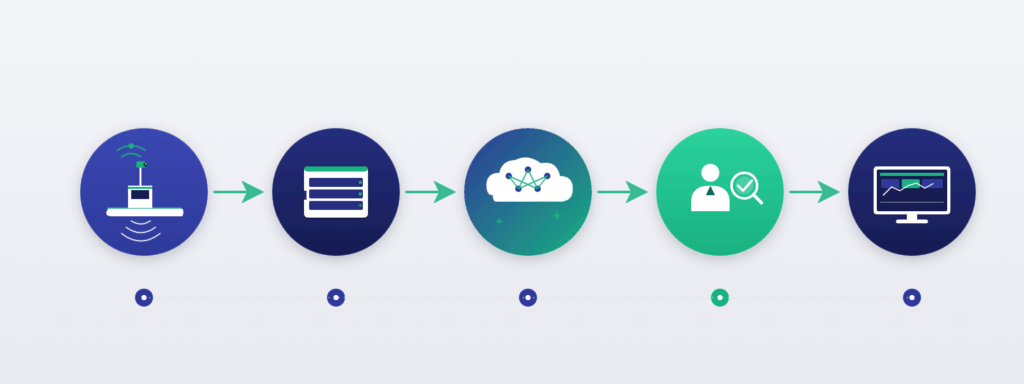
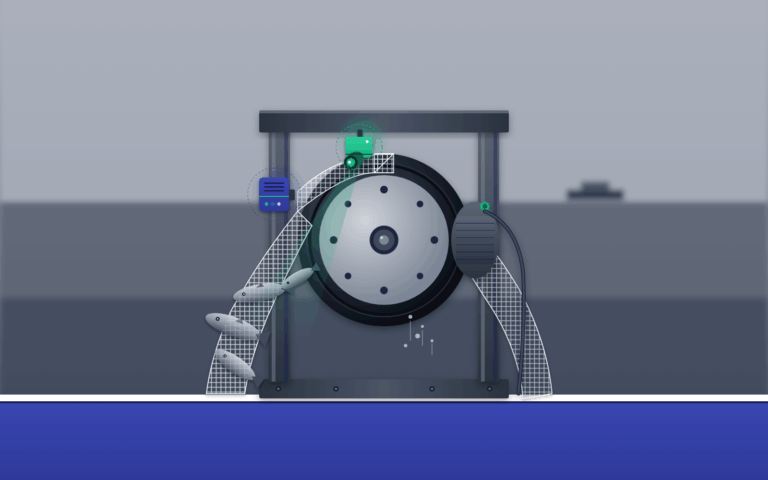
Remote Electronic Monitoring combines cameras, GPS, hauler sensors, and onboard storage to record what happens during fishing operations. A typical REM setup includes:
- Two to four cameras covering the haul-back area, the sorting belt, and the discard chute.
- A GPS receiver that timestamps and geolocates every event.
- A hauler sensor that detects when fishing gear is being retrieved, triggering recording automatically.
- An onboard hard drive that stores encrypted video for shore-side review.
The footage is then pre-screened by AI to detect catch hauls, bycatch events, and discards. Trained reviewers validate the flagged events and label species, sizes, and discard reasons. The output is a time-stamped, vessel-linked dataset that regulators can use to verify compliance with the landing obligation.
Three features make REM data defensible in a regulatory context.
Continuous coverage. Unlike onboard observers, REM records every haul on every trip, with no gap. A 9-year program like OBSCAMe demonstrates that 100% coverage of equipped vessels is operationally feasible.
Traceability. Every event is linked to a vessel ID, a position, and a timestamp. The audit chain is intact from camera to regulator dashboard.
Standardisation. When the same REM protocol is applied across a fleet, the resulting dataset is directly comparable across vessels and seasons. This is what makes REM compatible with ICES stock assessment workflows.
Programs already using REM for landing obligation compliance
everal national and regional programs have integrated REM into their landing obligation enforcement strategy.
OBSCAMe (France) monitors cetacean bycatch and discarding behaviour in the Bay of Biscay gillnetter fleet. The program runs across more than 110 vessels with multi-year continuity.
OBSMer (France) has run since 2009 as an observer-based program, now complemented by REM trials on selected métiers.
CEFAS (United Kingdom) uses REM on around 20 vessels to monitor fishing and wildlife interactions, including bycatch of marine mammals and seabirds.
Catchcam (Denmark) and several Dutch and Spanish pilots have tested REM on demersal fleets, with formal regulatory adoption underway as part of the EU Control Regulation revision (Regulation EU 2023/2842) that entered into force in 2024.
What the 2023 EU Control Regulation changes
The revised EU Control Regulation 2023/2842 introduces an explicit role for REM in landing obligation enforcement. Member States are now required to:
- Deploy CCTV and other electronic monitoring on a risk-based sample of vessels above 18 metres engaged in fisheries with a high risk of non-compliance with the landing obligation.
- Apply REM on every vessel above 18 metres operating in zones flagged by ICES as high-risk for sensitive species bycatch.
- Ensure REM data feeds national catch and bycatch reporting.
This is the first time EU law treats electronic monitoring as a mainstream compliance tool rather than a research instrument. National programs now have a legal mandate to scale REM across their fleets within the implementation window set by the Commission.
What a national program needs to scale REM
Rolling out REM across a national fleet is not just a hardware project. Four conditions tend to separate successful programs from stalled ones.
A scalable platform. REM generates terabytes of video per vessel per year. The platform must ingest, store, and process that volume without slowing review cycles.
AI pre-processing. Manual review of every minute of footage is impossible at scale. AI is what makes review costs manageable, by surfacing only the events that need human attention.
Trained reviewers. AI detection alone is not enough for regulatory use. Certified observers, ideally with Ifremer-level training for EU programs, must validate every flagged event before it is reported.
Unified data output. REM video is one input among many. To be useful for ICES, the regulator, and the operator, the data must align with logbook records, VMS positions, and observer notes in a single standardised dataset.
Where Sinay fits
Sinay operates one of the largest REM and observer programs in EU fisheries, with 80,000+ REM hours processed, 20,000 days at sea, and 100+ vessels equipped. The platform combines AI-driven event detection, in-house Ifremer-certified observers, and a regulatory output layer designed for landing obligation reporting.
The result is one place to capture REM footage, observer records, and external data, then turn them into the catch and bycatch evidence regulators need.
FAQ
The EU landing obligation, set by Article 15 of the Common Fisheries Policy, requires fleets to land all catches of regulated species rather than discard them at sea. It applies in EU waters since 2019 and covers more than 180 stocks.
Every EU-flagged commercial vessel fishing for species subject to catch limits, including small-scale and large-scale fleets across the Atlantic, Mediterranean, Baltic, and North Sea.
Since 2024, the revised EU Control Regulation 2023/2842 requires Member States to deploy REM on a risk-based sample of vessels above 18 metres in fisheries with a high risk of landing obligation non-compliance.
VMS and AIS track vessel position. REM records what happens on deck: which species are caught, retained, or discarded. The two systems are complementary and are typically combined in modern monitoring programs.
Maritime Applications