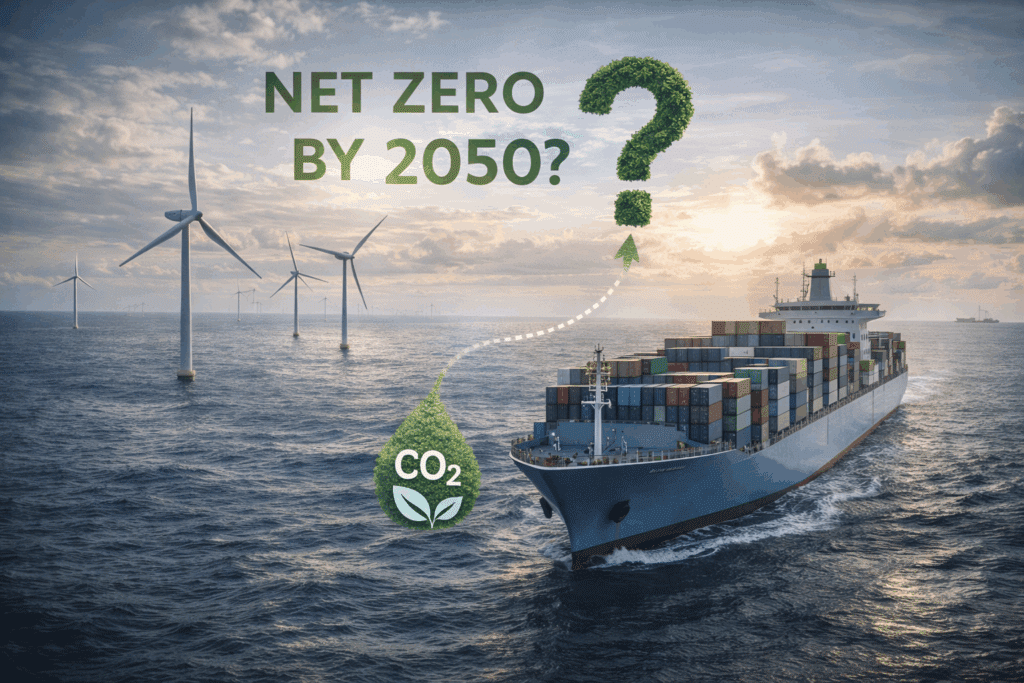
The maritime industry now faces a pressing challenge: decarbonization. According to the International Maritime Organization’s 2024 Fourth Greenhouse Gas Study, the global merchant fleet accounts for approximately 3% of worldwide CO₂ emissions—roughly 1 billion tons annually. In response, the IMO’s revised strategy mandates achieving net-zero greenhouse gas emissions by or around 2050, with intermediate targets requiring at least 40% reduction by 2030.
These realities therefore demand a shift from incremental efficiency improvements to transformative action based on alternative fuels, operational optimization, and data-driven decision-making.
The net zero imperative: regulatory and market pressures
Carbon neutrality in shipping rarely emerges from voluntary action alone. Rather, it results from converging pressures—regulatory, financial, and reputational. The IMO’s 2023 revised strategy represents the most ambitious decarbonization timeline in maritime history, requiring at least 20% GHG reduction by 2030 and 70% by 2040 compared to 2008 baselines.
Market-driven forces amplify regulatory mandates. For instance, the Poseidon Principles, adopted by financial institutions representing $185 billion in shipping portfolios, now require climate alignment assessments for financing. Moreover, Environmental, Social, and Governance (ESG) criteria increasingly determine access to capital, with investors scrutinizing emissions performance alongside traditional financial metrics. Meanwhile, the Sea Cargo Charter commits cargo owners to transparent emissions reporting, thereby creating competitive pressure on carriers to demonstrate verifiable reductions.
Regional regulations add immediate compliance urgency.
The European Union’s Emissions Trading System (EU ETS) extended to maritime transport in 2024, requiring shipping companies to surrender allowances for CO₂ emissions from EU port voyages. Similarly, the Fuel EU Maritime regulation establishes progressively stringent greenhouse gas intensity limits, declining to 80% reduction by 2050. When combined with Carbon Intensity Indicator (CII) ratings—which directly influence valuations and insurance premiums—these frameworks collectively create powerful economic incentives for decarbonization.
A compelling example is Maersk Line’s commitment to net-zero by 2040—ten years ahead of IMO goals. Achieving this required ordering methanol-capable vessels at 30% premium costs and establishing renewable methanol offtake agreements. Consequently, the company’s strategy illustrates how ambitious corporate targets can accelerate infrastructure development and technology adoption beyond regulatory minimums, demonstrating leadership in maritime decarbonization.
Alternative marine fuels: a patchwork of solutions
Achieving carbon neutrality requires moving beyond fossil fuels. Yet, no single alternative currently offers the energy density, handling characteristics, global availability, and cost competitiveness of heavy fuel oil. Therefore, the maritime industry faces a portfolio of potential solutions, each with distinct advantages and limitations across ship types and trade routes.
Liquefied natural gas (LNG) represents the most mature option, with approximately 300 LNG-fueled ships operating globally. LNG reduces CO₂ emissions by 20% compared to conventional fuels while virtually eliminating sulfur oxides. However, methane slip during combustion—methane being 28-36 times more potent than CO₂ as a greenhouse gas—significantly compromises lifecycle benefits. Accordingly, DNV’s Maritime Forecast positions LNG as transitional rather than ultimate solution.
Methanol emerges as particularly promising for medium-term decarbonization. Green methanol produced from renewable electricity and captured CO₂ achieves near-zero lifecycle emissions. The fuel remains liquid at ambient conditions, which in turn simplifies storage compared to cryogenic options. Maersk’s orders for methanol-capable craft reflect confidence in this pathway, though renewable methanol production remains insufficient for large-scale adoption.
Ammonia represents a potentially transformative long-term solution for deep-sea shipping. Containing no carbon, ammonia eliminates CO₂ emissions during combustion when properly managed. According to the IEA’s Net Zero by 2050 scenario, ammonia could fuel 45% of shipping energy demand by mid-century. Nevertheless, significant challenges remain: toxicity requires enhanced safety protocols, energy density is lower than conventional fuels, and combustion generates nitrous oxide requiring mitigation systems.
NYK Line and IHI Corporation’s 2024 ammonia-fueled tugboat trials demonstrated the first commercial-scale ammonia combustion in marine applications. In addition, the craft incorporated advanced safety monitoring and dual-fuel backup capability.
Biofuels and e-fuels offer drop-in compatibility with existing engines, potentially accelerating adoption. Yet, sustainable feedstock availability remains limited relative to maritime fuel demand. Furthermore, e-fuels require substantial renewable electricity—approximately 3-4 times the final fuel’s energy content. This creates cost challenges and competition with direct electrification of other transport sectors.
The fundamental reality is that no single fuel addresses all requirements. Consequently, short-sea shipping may adopt battery-electric propulsion; medium-range vessels might utilize methanol; and long-distance carriers could require synthetic fuels. This fragmentation multiplies infrastructure investment requirements and complicates global standardization.
Operational and technological pathways to decarbonization
Beyond fuel substitution, substantial emissions reductions derive from operational optimization and technological innovation. These approaches offer immediate implementation potential without waiting for new fuel infrastructure. Moreover, CII and EEXI regulations create compliance imperatives driving efficiency measure adoption across existing fleets.
Hydrodynamic optimization represents an accessible emissions reduction. Advanced computational fluid dynamics enables hull refinements reducing resistance by 5-10%. Additionally, air lubrication systems inject micro-bubbles beneath hulls, creating friction-reducing layers that decrease fuel consumption by 5-15%. Together, these improvements can reduce a ship’s emissions by 20-30% without fundamental propulsion changes.
Weather routing optimization leverages meteorological forecasting and oceanographic modeling to identify fuel-efficient passages. In this context, modern algorithms balance voyage duration against consumption, while accounting for wave heights, current patterns, and wind conditions. Consequently, studies document 3-8% fuel savings through optimized routing compared to great-circle navigation.
Predictive maintenance powered by artificial intelligence transforms traditional time-based schedules into condition-based interventions. By continuously monitoring engine parameters and performance indicators, operators can detect performance degradation early. Research demonstrates 4-7% consumption reductions through predictive maintenance compared to conventional practices.
Wärtsilä’s 2023 implementation of AI-powered voyage optimization across 50 container ships achieved remarkable results. Over twelve months, the fleet averaged 6.2% fuel consumption reduction and 8,400 tons CO₂ equivalent decrease. Moreover, economic savings exceeded $3.2 million, demonstrating environmental and financial alignment through intelligent optimization.
Wind-assisted propulsion technologies experience a renaissance through modern engineering. Rotor sails, rigid wing sails, and kite systems harness wind energy, supplementing mechanical propulsion. The International Windship Association reports that wind assistance reduces consumption by 10-30% depending on ship type and routes.
Sinay's contribution to operational efficiency
Our platform integrates diverse efficiency measures into comprehensive emissions monitoring and optimization systems. By synthesizing performance data, environmental conditions, and regulatory requirements, we enable operators to identify optimal combinations of speed adjustments, routing modifications, and technological interventions.
Furthermore, our metocean analytics platforms provide high-resolution forecasts, thereby enabling precise route optimization based on comprehensive environmental data and historical performance analysis.
Economic and logistical barriers to net zero
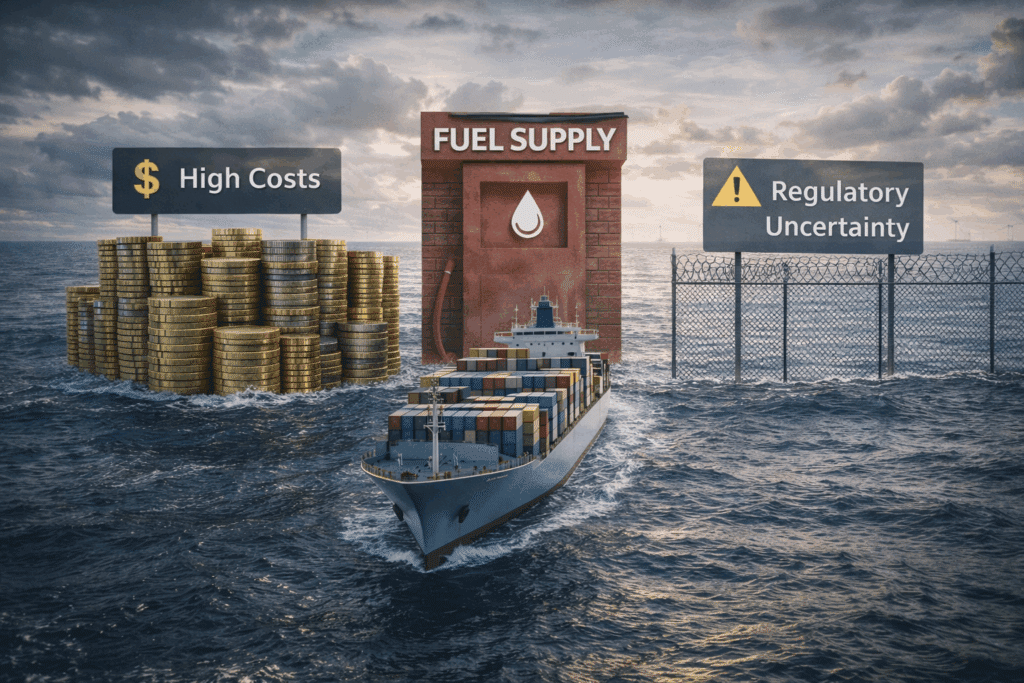
Despite technological feasibility, formidable economic barriers impede rapid decarbonization. The capital-intensive nature of shipping, long asset lifecycles, and fragmented ownership create inertia, which resists transformation. Understanding these impediments is therefore essential for designing effective interventions.
Vessel acquisition costs represent the most visible barrier. Alternative-fuel capable craft command 15-35% premiums over conventional designs. For large container vessels costing $150-200 million, premiums translate to an additional $25-60 million investment. Consequently, many operators—particularly small and medium companies—lack capital access without supportive financing.
Fuel cost uncertainties compound investment risks. New fuels like renewable ammonia and synthetic options currently cost 2-4 times conventional marine fuels. Shipowners making 20-30 year decisions confront trajectories that could render their fleet economically uncompetitive. As a result, this uncertainty paralyzes decision-making for operators lacking financial reserves.
Infrastructure requirements extend beyond the craft. Bunkering for these fuels requires specialized storage, transfer equipment, and safety systems. Moreover, the chicken-and-egg dilemma – vessels won’t order without bunkering availability, ports won’t invest without demand – delays ecosystem development. Breaking this impasse therefore requires coordinated public-private investment.
DFDS announced in 2023 that retrofitting existing craft would cost more than new construction while providing shorter lifespans. Consequently, the company committed to methanol-capable newbuilds while operating conventional ships until scheduled retirement. This pragmatic approach acknowledges retrofit limitations while advancing fleet decarbonization within economic constraints.
International competition creates carbon leakage risks. Stringent regulations may incentivize cargo routing through less-regulated jurisdictions. Accordingly, the OECD warns that asymmetric regulations could shift rather than reduce global emissions. This dynamic necessitates internationally coordinated policies preventing regulatory arbitrage.
Financing mechanisms must evolve to support decarbonization at required scales. The Climate Bonds Initiative estimates shipping requires $1-1.4 trillion investment by 2050. Hence, public development banks and multilateral institutions must provide concessional financing, thereby de-risking early investments. Additionally, carbon pricing generating transition support revenues could create self-funding frameworks.
Turning data into action: how digital monitoring supports decarbonization
Carbon neutrality depends fundamentally on comprehensive emissions quantification and operational optimization. In particular, data-driven decision-making transforms abstract commitments into measurable actions. Digital monitoring provides visibility, analytics, and predictive capabilities, which are essential for navigating regulatory landscapes while optimizing performance.
Regulatory compliance increasingly demands granular emissions reporting. The EU’s Monitoring, Reporting, and Verification (MRV) regulation requires detailed fuel consumption and emissions data. Meanwhile, CII ratings—assigning craft grades A through E—directly influence valuations, insurance premiums, and chartering preferences. Therefore, maintaining favorable ratings requires continuous monitoring that exceeds traditional practices.
Real-time emissions monitoring enables proactive management rather than retrospective reporting. Modern platforms integrate AIS data tracking movements, fuel consumption sensors, and meteorological data. This synthesis calculates emissions with voyage-level granularity, thus identifying high-consumption segments for targeted improvements.
Predictive analytics transform historical performance into forward-looking guidance. Machine learning algorithms analyze relationships between speed, loading, weather, and consumption to recommend optimal parameters.
Moreover, these systems account for craft-specific characteristics—hull fouling, engine efficiency, trim optimization—thereby delivering personalized recommendations. Studies demonstrate that data-driven optimization reduces emissions 8-15% compared to conventional operations.
Sinay’s real-time monitoring solutions
Our implementation with a European short-sea operator demonstrated practical benefits of comprehensive digital monitoring. Specifically, the company deployed our integrated platform across 18 vessels, combining real-time emissions tracking with metocean analytics and route optimization. Over 18 months, the fleet achieved 11.3% average fuel consumption reduction, with a corresponding emissions decrease of approximately 14,800 tons CO₂ equivalent. Additionally, the system identified that speed reductions during specific weather conditions yielded disproportionate gains. Furthermore, automated regulatory reporting reduced administrative burden by 65%, allowing personnel reallocation to strategic sustainability initiatives.
The metocean analytics advantage
Our platform provides sophisticated environmental intelligence supporting route optimization and operational planning. High-resolution ocean current modeling, wave forecasting, and wind pattern prediction enable identification of fuel-efficient passages while accounting for performance characteristics. In addition, integration with emissions monitoring creates closed-loop optimization—recommended routes generate performance data that refines future predictions, continuously improving accuracy.
Data as collective intelligence
We believe maritime decarbonization represents fundamentally a data challenge as much as a technology challenge. Physical solutions largely exist; however, the persistent gap lies in systematic deployment guided by comprehensive performance visibility. Our platform democratizes access to sophisticated analytics, thereby enabling operators of all sizes to make evidence-based decarbonization decisions. This approach accelerates the transition through measurable, verifiable actions rather than aspirational commitments alone.
FAQ
The main economic barriers include high upfront investment costs, uncertainty around return on investment, and limited access to financing for low-carbon technologies. In sectors like shipping and logistics, transitioning to alternative fuels, new vessels, or upgraded infrastructure often requires significant capital, while market incentives and regulatory frameworks remain uneven across regions.
Logistical barriers include limited availability of low-carbon fuels, lack of standardized infrastructure, fragmented supply chains, and operational constraints such as route variability and port readiness. These challenges make it difficult to deploy sustainable solutions consistently at a global scale.
High-quality data improves emissions measurement, scenario analysis, and investment planning, while better coordination between stakeholders helps align infrastructure development, operations, and regulatory compliance. Together, they enable more informed decision-making and reduce uncertainty around the net-zero transition.