
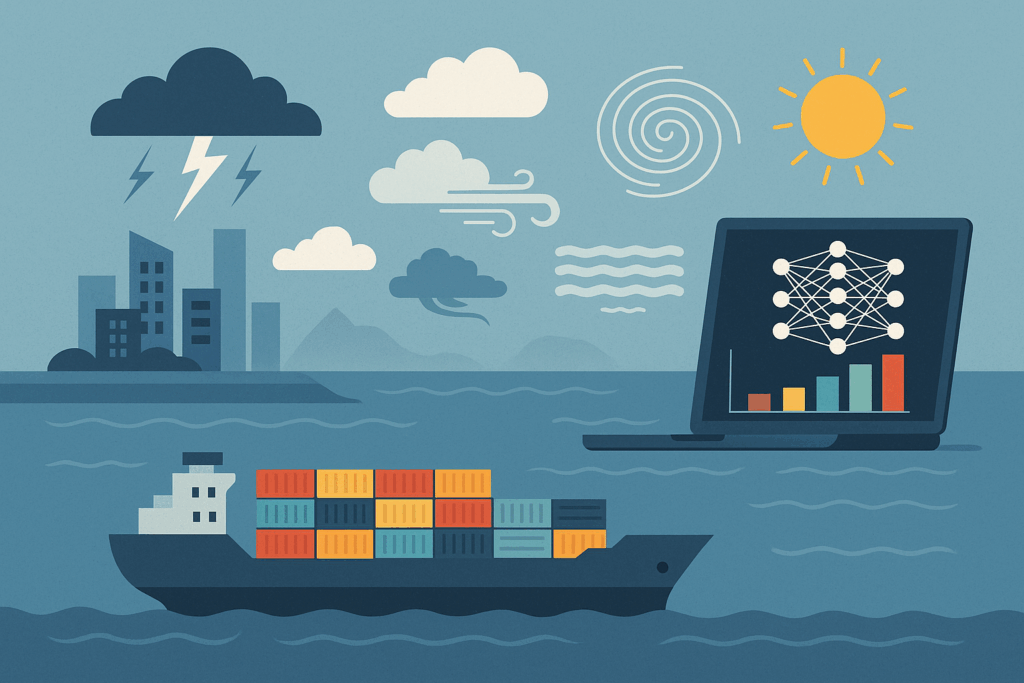
The Role of Machine Learning in Mesoscale Weather Prediction for Maritime Logistics 

Environmental Impact Assessments and Risk Management

In the challenging world of maritime operations, understanding mesoscale weather conditions is crucial. Our cutting-edge machine learning solutions provide you with accurate, real-time data and forecasts, enabling you to make informed decisions, enhance safety, and maximize efficiency in your marine projects.

Empower Your Maritime Projects With Machine Learning Intelligence

Enhanced Accuracy

Make data-driven decisions with accurate mesoscale forecasts and historical analyses for improved maritime planning.
 

Risk Mitigation

Identify and prepare for potential weather-related challenges before they impact your operations.
 

Operational Efficiency

Optimize schedules, resource allocation, and energy production with tailored ML insights.

Benefits Of Machine Learning Weather Prediction

Maximize your maritime potential with data-driven insights

Improved Planning

Optimize project schedules and resource allocation through advanced ML forecasting models.
 

Safety Enhancement

Ensure safer working conditions for offshore personnel through predictive weather analytics.
 

Risk Mitigation

Identify and prepare for potential weather-related risks before they impact operations.
 

Environmental Compliance

Meet regulatory requirements for environmental impact through accurate forecasting.
 

Performance Optimization

Maximize efficiency of maritime operations through intelligent weather pattern analysis.
 

Cost Reduction

Minimize weather-related delays and operational disruptions through predictive insights.

Key Machine Learning Techniques

Critical ML elements affecting maritime operations
 

Neural Networks

Replicate brain-like structures to detect complex patterns in meteorological data, effective for high-resolution tasks like predicting humidity, wind, and short-term anomalies.
 

Random Forests

Aggregate decision trees to improve forecast accuracy and reduce sensitivity to noise or missing data—critical for extreme weather classification.
 

Deep Learning

Automatically extracts features from raw inputs, improving forecasts of coastal winds, rainfall, and ocean conditions through ensemble modeling.

Proven Applications

Coastal Storm Forecasting

Neural networks trained on global weather datasets predict storms up to 48 hours in advance with over 85% accuracy. These forecasts support safe vessel operations, optimize maintenance schedules, and coordinate vessel transfers, ultimately helping reduce delays and optimize operational costs.

Fog Detection for Ship Safety

ML models trained on humidity, wind, and temperature data reduced fog-related delays by 30% in ports like Rotterdam. Accurate forecasts improve fuel efficiency and reduce unexpected delays, leading to smoother and more cost-effective maritime logistics.

AI-Driven Rainfall Predictions

Deep learning enables early forecasts of heavy port-specific rain, helping ports optimize loading and reduce congestion. Reliable forecasting minimizes risks and ensures efficient, uninterrupted project execution in challenging marine conditions.

Challenges and Future Outlook

Despite its promise, ML forecasting faces several challenges that organizations must address:

– Data Quality Requirements
– Training requires large, consistent datasets
– Model Interpretability
– Limited ability to explain prediction mechanisms
– Computational Demands
– High processing requirements and evolving regulations

Understanding these challenges helps organizations better prepare and allocate resources for ML-related implementations.

Key Impact Areas

Improved Planning

Strategic scheduling during favorable weather windows to minimize downtime
 

Risk Management

Development of contingency plans and alternative work procedures
 

Technology Investment

Utilizing advanced forecasting tools to better predict and manage downtime
 

Resource Optimization

Efficient allocation of resources based on weather forecasts

Sinay's Metocean Analytics Platform

Modern machine learning and forecasting technologies enable better maritime management through:

Real-time Monitoring

Continuous monitoring of weather conditions and automated alerts for changing conditions.

Predictive Analytics

Advanced forecasting models that help predict potential downtime periods with greater accuracy.

Integration Capabilities

Seamless integration with project management and operational planning systems.

FAQ about environmental monitoring for offshore projects

Still have questions?

Contact us!

Contact us

They help ensure regulatory compliance, minimize environmental impact, and optimize operations by tracking key factors like water quality, emissions, and noise levels.

Advanced sensors, IoT devices, AI, and real-time data analysis are used to collect and process environmental data for better decision-making.

They detect pollution, habitat disturbances, and climate-related threats early, allowing proactive measures to prevent damage.

Sectors like oil & gas, wind energy, and aquaculture use these systems to maintain sustainability and improve efficiency.

Our Products

Tools

You may also like: